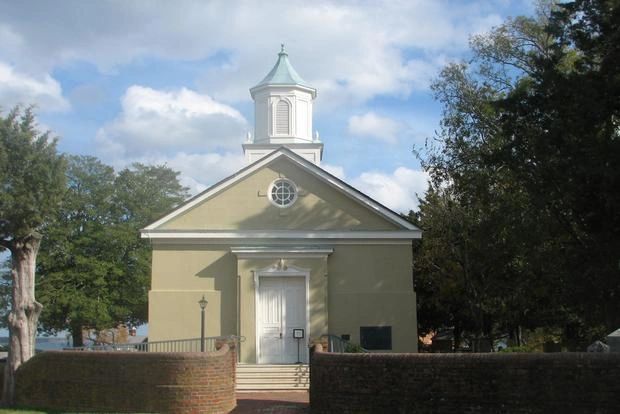
A National Historic Landmark, 1697

The Grace Historical Church Preservation Foundation was established as an independent 501(c)3 corporation in order to collect tax deductible funds for the maintenance and preservation of the historic church building. Rebuilt on the original marl walls, the church has witnessed over 300 years of our country's history, from the earliest settlements of the founding of our nation, through fire and two wars, to its present role serving an active Episcopal congregation.

The churchyard contains graves that date from the 1600's and include Thomas Nelson, Jr., signer of the Declaration of Independence, and his family.

Preserving our nation's heritage is a privilege and an honor. We invite you to make a contribution towards the maintenance of this national treasure so that it may continue to invoke the spirit of the past for future generations.


  • Outright gifts - may be funded with cash or securities, provide an income tax deduction and offer immediate support.

  • Memorial contributions

  • Estate gifts - transfer after your lifetime, allow continued use of your assets during your lifetime and provide charitable estate tax deduction.

  • Charitable Gift Annuity - Administered by the Episcopal Church Foundation, enables you to make a substantial gift now and still receive interest income from those assets for yourself as long as you live. To establish a charitable gift annuity, contact the Episcopal Church Foundation toll free at (800) 697-2858, or visit www.episcopalfoundation.org.


  • Funding is needed for the next repairs: restoration of the steeple and roof replacement. Contributions designated specifically for church preservation can be made to:


    The Grace Historical Church Preservation Foundation
    P.O. Box 133
    Yorktown, VA 23690


    Grace Historical Church Preservation Foundation Report

    May 2011


    Our Civil War Connection

    by Lois Winter


    This year and next there will be commemorative events for the 150th anniversary of the Civil War on the peninsula. On April 17, 1861, Virginia voted to secede from the Union. June 10 of the same year, the Battle of Big Bethel, the first land battle of the Civil War, took place near the current Big Bethel Reservoir. In March of the following year, 1862, 120,000 Union troops under the leadership of General George McClellan landed at Ft. Monroe and made their way to Yorktown. They brought with them 300 pieces of artillery, 2500 head of cattle, and more than 25,000 horses and mules. Where did they put them in little Yorktown?! At the time it was called the "largest amphibious operation ever seen by the modern world." We have photographs of our church surrounded by some of that artillery.


    We recently discovered another Grace connection to the Civil War era. As Kevin James was sanding the window frame on the north side of the church, he uncovered graffiti carved into the wood that read, "R W Moreland August 16, 1870." I asked local historian Frank Green what he knew about Yorktown in this time period, five years after the end of the Civil War.


    According to Frank, reconstruction had ended and Virginia was ready to reenter the Union. The state basically had to start over from nothing. In searching the county records, Frank found that 1870 was the year that Virginia adopted a new state constitution that called for the revamping of county governments. As a result, The York County Board of Supervisors first met on October 3, 1870. (2 months after the graffiti) At that time, the Board decided to build three buildings: a County court clerk's office, a courthouse and a jail.


    I decided to check the names on the War Monument in front of York Hall which lists names of York County residents who gave their lives in past wars. Under those who died in the Civil War, there was a listing for "Darius Moreland." Possibly a relative of R W Moreland? Clues to the past are offered by the building that witnessed it.


    Update on Repairs


    It is an honor for the Grace Historic Church Preservation Foundation to play a role in restoring the little church that still stands after surviving all these past events. The Foundation has spent over $14,000, collected from private donations, to support the team of David Miller, Daryl Douglas and Kevin James as they work on the restoration of the sanctuary. They have been meticulously painting and replacing rotting wood while they carefully preserve historical accuracy. The following is an update of what they have accomplished:


    • The stucco walls were repaired and painted, cracks were filled with an elastomeric compound, and two coats of paint were applied.
    • The trim fascia boards and soffits were stripped to bare wood, primed with oil base primer, and were painted with two final coats of paint by Kevin James.
    • At the back facade of the sanctuary, cornice moldings were hand-fabricated and placed by Daryl Douglass.
    • Wrought-iron rails and vents were sanded and painted.
    • All exterior doors were restored, repainted, or replaced. This included the custom fabrication of a door to the entrance of the crawl-space, embellished with wrought- iron hardware.
    • Kevin James has completed the restoration of the six sanctuary windows. This restoration included the following: the wood rot was repaired, the window panes were glazed, and the woodwork was primed and painted with two exterior coats.
    • The interior surfaces of the six sanctuary windows were also stripped bare and repainted with high gloss oil base paint.
    • The circular, exterior window of the front facade was refurbished by Daryl Douglass. This involved the replacement of circular trim pieces, which were made by hand.
    • The Sacristy windows are currently being restored by Daryl Douglass and David Miller.

    The Foundation wishes to thank David, Daryl, and Kevin for their work which reflects their dedication to historical preservation. The people of Grace can be proud of our old building as we welcome visiting tourists to the site where two wars were fought and so many lives were lost. With its fresh paint and new trim, our little church truly stands as a beacon to the nation, and a reminder of the events that shaped our history.


    "Burned, desecrated, altered and repaired, but never completely abandoned, the church has come through its vicissitudes to be rebuilt ever stronger and each time more firmly placed in the hearts of those who worship within its walls."

    Clyde F. Trudell
    Colonial Yorktown, 1938


    Communion silver, 1649
    Still in use today